How Much Does It Cost to Restring an Acoustic Guitar?
Updated · The Acoustic Guitarist
Restringing an acoustic guitar yourself costs one set of strings, about $10 for a standard set to $22 for a coated one. A shop adds labour; Guitar Center listed its restring at $24.99–$34.99 labour only, so about $35–$57 in total with strings. Prices checked 28 October 2026; shops vary, so ask whether strings are included.
On this page 6
What you pay, three ways
| Option | What you pay | Time | Best when |
|---|---|---|---|
| Do it yourself | One set of strings, about $9.99 uncoated to $21.99 coated** (a string winder and cutters are a one-time buy) | 20–40 min | You can learn it once and save every time |
| Shop restring | Strings plus labour. Guitar Center listed $24.99–$34.99 labour, parts extra*, so about $35–$57 with a set from the row above | Same day or drop-off | You want it done for you |
| Restring with a setup | Strings plus a setup charge. Guitar Center listed its Signature Setup at $59.99–$69.99 labour, parts extra* | Usually a drop-off | The guitar is hard to play or buzzes |
*Prices from the Guitar Center repairs page, checked 28 October 2026. Guitar Center says starting rates vary by location. Independent shops set their own prices, and some include strings in the restring fee, so ask before you book.
**String prices from Alamo Music, checked 28 October 2026: D’Addario EJ16 Phosphor Bronze Light (12–53) at $9.99 and Elixir 16052 Nanoweb Phosphor Bronze Light (12–53, coated) at $21.99 per set. Other retailers and sales will differ.
The strings are the part you control. String prices depend on brand, material and whether they are coated. In the example above the coated set costs about twice as much as the uncoated one, but coated strings usually stay bright for longer, so the cost per month of playing can come out close.
Which strings to buy
Most steel-string acoustics ship with light gauge strings. Gauge sets are named by the thickness of the high E and low E in thousandths of an inch:
| Name | Typical gauges (high E to low E) | Feel |
|---|---|---|
| Extra light | .010–.047 | Easiest to press, thinner sound |
| Custom light | .011–.052 | Easy, a good beginner choice |
| Light | .012–.053 | The usual factory gauge |
| Medium | .013–.056 | Louder, more bass, harder to press |
Stay with the gauge the guitar came with unless you have a reason to change. Moving up or down a step changes the pull on the neck and can change the action, so you may need a small truss rod adjustment. For material, phosphor bronze sounds warm and lasts well; 80/20 bronze sounds brighter at first and dulls faster.
Nylon-string (classical) guitars take nylon sets sold by tension (normal, high), never steel strings. Every gauge, material and coating side by side: acoustic guitar strings.
How often to restring
Change your strings when you notice any of these:
- the sound has gone dull and the notes die quickly,
- the wound strings look dark or rough under your fingers,
- the guitar will not stay in tune, or chords sound out of tune up the neck even after tuning,
- a string has broken.
Players who play most days often change every one to three months; occasional players can go longer. If you sweat a lot or play hard, it will be sooner.
How to restring an acoustic guitar
You need a new set, a string winder (optional but quick), wire cutters and the guitar tuner. These steps are for a steel-string guitar with bridge pins.
- Loosen all six strings with the tuners until they are slack. Change them one at a time if you prefer to keep tension on the neck; both ways work on a healthy guitar.
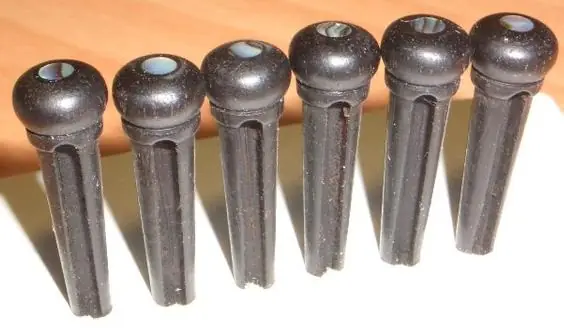
- Remove the bridge pins. Use the notch on a string winder, or push the string into the guitar slightly to free the pin. Do not pry against the bridge with pliers.
- Unwind the old strings from the tuner posts and pull them out. This is a good moment to wipe the fretboard and top.
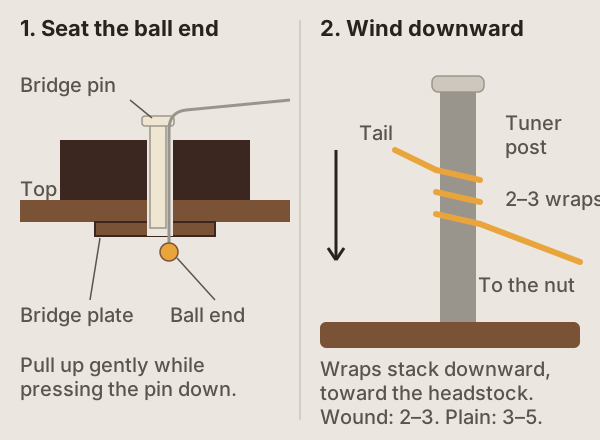
- Fit the new string’s ball end into its bridge hole and push the pin back in with the pin’s groove facing the string. Pull the string up gently while pressing the pin so the ball seats against the bridge plate inside, not on the tip of the pin.
- Thread the string through the tuner post, pull it tight, then pull back some slack: about two to three inches (5–7 cm) past the post for the wound strings and a little more for the thin ones.
- Wind it on so the string wraps downward around the post, with the turns stacking toward the headstock. Two to three wraps for wound strings and three to five for plain strings is plenty. Keep slight tension on the string with your other hand as you wind.
- Repeat for the other five strings, then tune to pitch: E, A, D, G, B, E from the thickest string.
- Stretch the strings. Pull each one gently away from the fretboard along its length, retune, and repeat two or three times. New strings keep going flat until they have stretched.
- Cut the ends about a centimetre past the post. Cut ends are sharp, so do not leave long tails.
On a classical guitar the strings are tied at the bridge with a loop knot and threaded through the holes in the tuner rollers instead of pins and posts; the stretching takes longer, often several days.
Common restringing mistakes
- Ball end caught on the pin: the string slips or the pin pops up. Push the pin in, pull the string up, then press the pin down again.
- Too few wraps: the string slips at the post and will not hold pitch.
- Too many wraps: the coils pile up and cross over, which makes tuning unstable.
- Skipping the stretch: the guitar keeps going flat for days.
- Tuning the wrong string up: check that you are turning the tuner of the string you are playing; snapping a new string by tightening the neighbour is a classic.
When a restring is not enough
If the guitar still buzzes, feels hard to press or plays out of tune after fresh strings and careful tuning, the problem is probably the setup rather than the strings. See how to tell if a guitar needs a setup.
FAQ
Is it worth paying a shop to restring a guitar?
For a first restring it can be, especially if the shop also checks the action and neck. Restringing is easy to learn, though, and once you have done it two or three times it takes about 20 to 30 minutes at home.
How often should I change acoustic guitar strings?
When they sound dull, look dark, feel rough or stop staying in tune. For someone playing most days that is often every one to three months. Coated strings usually last longer than uncoated ones.
Should I change all six strings at once?
Yes, as a rule. A single new string sounds brighter than the old ones around it. Replace one string alone only if it breaks and the rest are fairly new.
Can I put steel strings on a classical guitar?
No. Classical guitars are built for the low tension of nylon strings. Steel strings can bend the neck and pull the bridge off the top.