Acoustic Guitar Strings: Types, Gauges and How to Choose
Updated · The Acoustic Guitarist
A standard acoustic guitar has six strings tuned E A D G B E from thickest to thinnest. Steel-string guitars take steel sets, most often light gauge (.012–.053) in bronze or phosphor bronze; classical guitars take nylon and must never be fitted with steel. Gauge, material and coating change feel, tone and how long a set lasts.
On this page 8
String names and notes
In standard tuning the six strings, from the thickest (nearest your face) to the thinnest, are:
| String | Note | Thickness |
|---|---|---|
| 6th | E (low E) | Thickest, wound |
| 5th | A | Wound |
| 4th | D | Wound |
| 3rd | G | Wound on most light and heavier steel sets, plain on nylon sets |
| 2nd | B | Plain |
| 1st | E (high E) | Thinnest, plain |
Strings are numbered from the thin end, so “the first string” is the high E. Use the guitar tuner to check each string against its note, and see standard tuning for how the notes line up on the neck. For the parts the strings attach to, see the anatomy of an acoustic guitar.
String materials
Acoustic strings come in two families that are not interchangeable.
Steel strings (steel-string acoustics)
A steel-string set has a steel core. The plain strings (usually the top two) are bare steel; the thicker ones are wound with another metal. The winding gives each set its character:
- 80/20 bronze is a copper and zinc alloy, roughly 80% copper and 20% zinc. It is known for a bright, crisp tone that tends to soften as the strings age.
- Phosphor bronze adds a small amount of phosphorus to the bronze. It is commonly described as warmer than 80/20 and is the most common material on acoustic sets.
- Silk and steel sets use a lighter steel core with a silk or nylon layer under the winding. They run at lower tension and have a soft, mellow sound, and are often chosen for gentle folk playing.
Nylon strings (classical guitars)
Classical and flamenco guitars use nylon for the treble strings (1st to 3rd) and nylon cores wrapped with metal for the bass strings (4th to 6th). Nylon sets are sold by tension, usually normal or high.
Why steel and nylon are not interchangeable
Steel strings are tuned to a much higher tension than nylon. A classical guitar is braced and built for the low pull of nylon, and a steel set can warp the neck and lift the bridge from the top. The reverse also fails: nylon strings on a steel-string guitar sound weak and quiet. Match the strings to what the guitar was built for.
String gauge: sizes and what they change
Gauge is the thickness of a string in thousandths of an inch (.012 means 0.012 inch). Sets are named for their overall weight, and the usual labels are:
| Set name | Typical gauges (high E to low E) | What you notice |
|---|---|---|
| Extra light | .010–.047 | Easiest to press, thinner and quieter sound, bends easily |
| Custom light | .011–.052 | Easy to play, a popular beginner and fingerstyle choice |
| Light | .012–.053 | The usual factory gauge, a balance of feel and volume |
| Medium | .013–.056 | Loudest and fullest bass, hardest to press, highest tension |
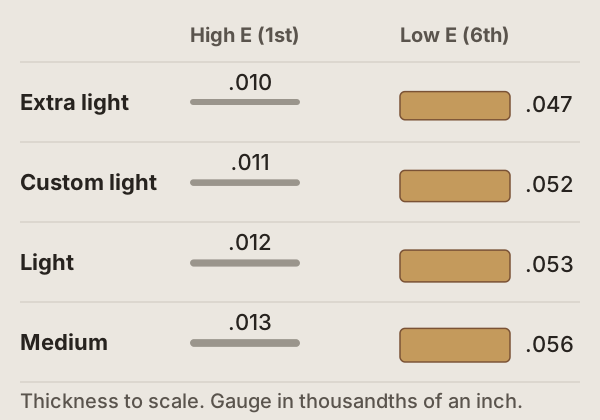
Exact gauges vary by brand and set, but those are the typical figures. Moving up a gauge generally does three things:
- Playability: heavier strings need more finger pressure and can tire a beginner’s hand.
- Volume and tone: more string mass tends to drive the top harder, giving more volume and bass.
- Tension: heavier strings pull harder on the neck and bridge, which can change the action and may call for a truss rod adjustment. If you switch gauges and the guitar feels different, see how to tell if a guitar needs a setup.
Some lightly built or vintage guitars are designed for lighter strings. If you are unsure what your guitar was built for, check the maker’s recommendation before putting on a heavier set.
Coated vs uncoated strings
Uncoated strings are bare metal. They sound brightest when new and are the cheapest, but sweat, skin oils and dirt build up in the winding and the tone fades.
Coated strings have a thin polymer layer, either over the strings or around the winding. The aim is to slow the build-up that dulls a set, so coated strings usually keep their tone longer. The trade-offs are a higher price per set and a surface that some players feel is smoother or slightly less grippy. Elixir is well known for coated acoustic strings, and D’Addario also makes coated lines.
Neither is better in every case. If you play daily or have sweaty hands, coated strings can reduce how often you restring. If you restring often anyway or like the bright snap of a fresh uncoated set, uncoated is cheaper.
How to choose a set
Start from the guitar. Check whether it is steel-string or classical, and keep to the gauge it shipped with unless you have a reason to change. Then adjust for how you play.
- Beginner: custom light or extra light are gentler on the fingertips. Light is fine if the guitar is set up well.
- Fingerstyle: many players like lighter gauges for easier fretting and a clear, even tone, though some prefer light or medium for more volume. See guitars for fingerpicking.
- Strumming: light or medium gives more volume and bass, which suits chord playing, especially on a larger body.
- Small-body guitars: a parlor, concert or other small guitar is often happier with lighter strings, since a small top may not handle high tension as well. Check the maker’s guidance.
- Drop tunings: lowering a string slackens it, so it can feel loose and buzz. A heavier set, or a heavier low string, helps keep tension up in lower tunings.
- Warmer or brighter tone: phosphor bronze for warmer, 80/20 bronze for brighter. These are broad tendencies, not guarantees, and the guitar’s own wood matters just as much.
Changing strings is the cheapest way to change how a guitar feels, so it is fine to try a different set. The cost and the step-by-step method are in the restring guide.
When to change your strings
Change strings when they sound dull, look dark or stop holding their tuning; the full signs, timing and steps are in the restring guide.
Acoustic vs electric guitar strings
| Acoustic (steel) | Electric | |
|---|---|---|
| Typical light set | .012–.053 | .009–.042 |
| Material | Bronze or phosphor bronze wound, steel core | Nickel-plated steel or similar magnetic alloys |
| Made to | Move the guitar’s top and project sound | Be sensed by magnetic pickups |
| Tension | Higher | Lower |
Electric strings are thinner and rely on a magnetic response. Put them on an acoustic and they sound thin and quiet. Acoustic strings on an electric are heavier and many are not very magnetic, so a magnetic pickup picks them up weakly. Buy strings made for the type of guitar you have.
Common string brands
These are well-known makers of acoustic strings, listed as information, not a ranking:
- D’Addario makes a wide range of acoustic sets in bronze and phosphor bronze, including the EJ16 phosphor bronze light (.012–.053).
- Elixir is known for coated acoustic strings, such as its Nanoweb phosphor bronze line.
- Martin makes strings under the same name as its guitars.
- Ernie Ball makes acoustic strings, including its Earthwood 80/20 bronze line.
Most brands offer the same set names and gauges in several materials. Compare the gauge, material and coating on the packet rather than the brand name alone.
FAQ
What are the six strings on a guitar called?
From thickest to thinnest, in standard tuning, they are E (6th string), A (5th), D (4th), G (3rd), B (2nd) and E (1st). The strings are numbered from the thinnest, so the high E is string 1 and the low E is string 6.
What gauge strings should I use on an acoustic guitar?
Light (.012–.053) is the usual factory gauge for steel-string acoustics and a safe default. Custom light (.011–.052) or extra light (.010–.047) are easier on the fingers; medium (.013–.056) is louder with more bass but harder to press.
Can I use acoustic strings on an electric guitar, or electric strings on an acoustic?
Not usefully. Electric strings are made to be sensed by magnetic pickups and are thinner and lighter, so on an acoustic they sound thin and quiet. Acoustic strings are heavier, and many sets (bronze, phosphor bronze) are not magnetic enough to drive electric pickups well.
Are coated strings worth it?
Coated strings are designed to resist the sweat and grime that dull a set, so they usually stay bright longer than uncoated ones. They cost more per set, and some players find the surface slightly slicker. Whether the extra cost pays off depends on how often you play and how fast you wear strings out.
Do thicker strings sound better?
Thicker strings usually give more volume and bass because they move more of the top, but they also pull harder on the neck and are harder to fret. Better means better for your hands, your guitar and your style, not simply heavier.
Can I put steel strings on a classical guitar?
No. A classical guitar is built for the much lower tension of nylon strings. Steel strings can warp the neck and pull the bridge off the top.
How often should I change my strings?
When they sound dull, look dark or feel rough, or stop holding their tuning. For regular players that is often every one to three months. See the restring guide for the full signs and the steps.