What Are the Best Guitars for Fingerpicking?
Updated · The Acoustic Guitarist
The best guitars for fingerpicking have a wider neck (about 1 3/4 in or 44.5 mm at the nut, or more), wider string spacing at the bridge, a small to mid-size body such as an OM/000, grand concert or grand auditorium, low action and light strings. A classical nylon-string guitar is the widest-necked option of all.
On this page 6
This guide works from specs you can read on any product page. It is not a review of individual guitars.
The specs that matter, in order
| Spec | Look for | Why it helps |
|---|---|---|
| Nut width | 1 3/4 in (44.5 mm) or wider | More space between strings for your fingertips |
| String spacing at the saddle | About 2 1/8–2 1/4 in (54–57 mm) | Room for the picking hand to land cleanly |
| Body size | OM/000, grand concert, grand auditorium, parlor | Balanced sound and a narrow waist that sits well on the leg |
| Action | Low and even | Lighter touch, cleaner fast passages |
| Strings | Custom light or light | Easier to fret, quick response to a soft touch |
| Scale length | Any; shorter (about 24.9 in) feels slinkier | Shorter scales make stretches a little easier |
| Cutaway | Optional | Reach for melodies above the 12th fret |
Nut width and string spacing
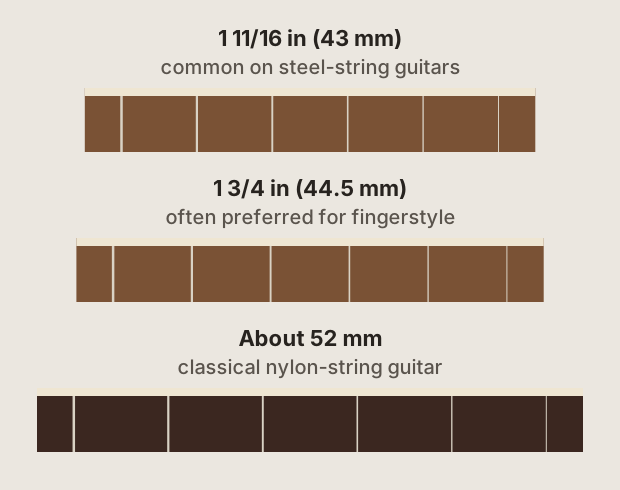
This is the spec that separates fingerstyle guitars from strumming guitars. Many steel-string acoustics are 1 11/16 in (about 43 mm) wide at the nut, which suits chords and smaller hands. Guitars sold for fingerstyle are often 1 3/4 in (about 44.5 mm) or wider, and some go to 1 7/8 in. Just as important is the string spacing at the saddle, the distance between the outer strings at the bridge. Wider spacing gives each finger of the picking hand its own clear lane.
If the spec sheet does not list it, measure in the shop: lay a ruler across the strings at the saddle, from the centre of the low E to the centre of the high E.
Body size
Medium and small bodies are the classic fingerstyle shapes:
- OM and 000 (auditorium). The traditional fingerstyle body, about 15 in wide at the lower bout with a narrow waist. Even from bass to treble.
- Grand concert (00). Smaller and very clear; each note stands apart.
- Grand auditorium. A little bigger; handles both fingerpicking and strumming.
- Parlor. Small, comfortable, with a dry, mid-focused voice suited to blues and old-time styles.
Dreadnoughts and jumbos work too, but their heavy bass can blur fast patterns. The full comparison is in acoustic guitar body styles and sizes.
Top wood
Spruce and cedar are both used on fingerstyle guitars. Cedar is often described as warmer and quick to respond to a soft touch; spruce as brighter, with more headroom when you play harder. The difference is smaller than the difference between a solid and a laminate top, and smaller than the effect of the setup. A solid top is the spec to insist on if your budget allows.
Action and strings
A low, even action lets you play with a lighter touch, and fingerstyle relies on light, controlled attacks. Our setup checklist shows how to measure it. Many fingerstyle players use custom light (.011–.052) or light (.012–.053) strings; see the gauge table in how much it costs to restring an acoustic guitar.
Steel-string or nylon?
- Nylon (classical): neck about 52 mm wide at the nut, flat fretboard, soft strings. The natural choice for classical, flamenco and bossa nova. Very kind to fingertips.
- Crossover nylon: a nylon-string guitar with a narrower neck and often a cutaway and pickup. A middle ground for steel-string players who want the nylon sound.
- Steel-string: brighter and louder, needed for most folk, blues, ragtime and modern fingerstyle. Pick one with a wider nut.
A first fingerpicking pattern
The basic pattern for most folk and country fingerpicking is alternating bass: the thumb alternates between two bass strings on the beat while the fingers pick the higher strings between the beats. Merle Travis made it famous, and it is often called Travis picking.
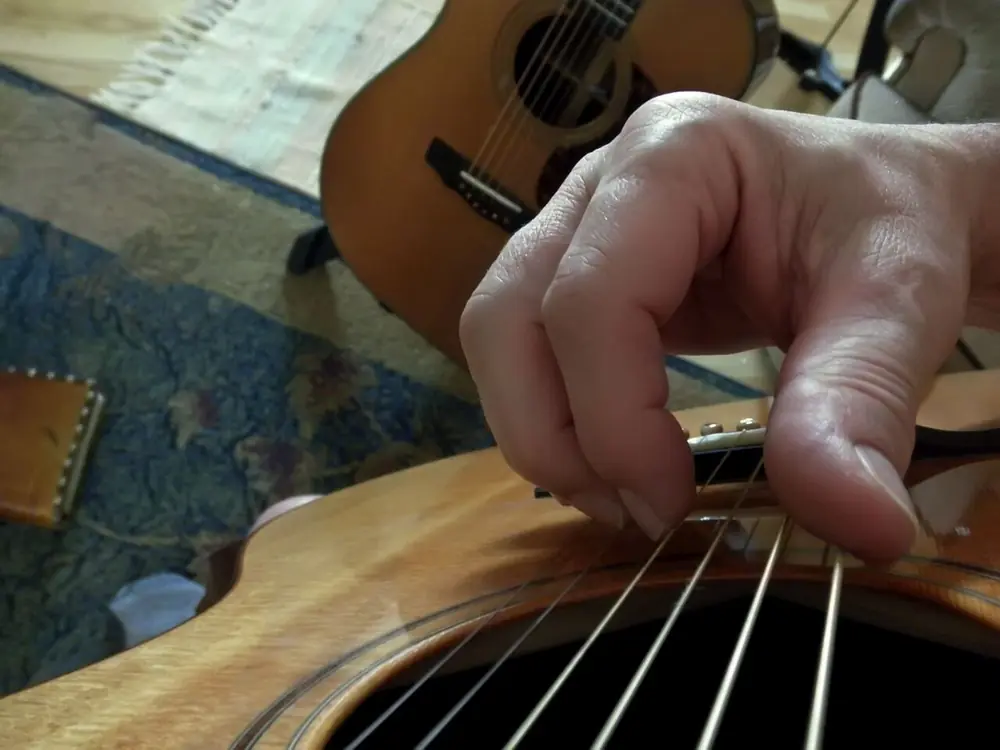
Start with these two chords:
- On C: the thumb alternates between the 5th string (the root, C at the 3rd fret) and the 4th string. The index and middle fingers pick the 2nd and 1st strings.
- On G: the thumb alternates between the 6th string (the root, G at the 3rd fret) and the 4th string, fingers as before.
Count “1 and 2 and 3 and 4 and”. Thumb on every number, a finger on every “and”. Play it slowly until the thumb runs on its own; speed comes later. Both chords are in the key of G major, which shows the other chords that fit with them.
Tunings that fingerstyle players use
Open and modal tunings let open strings ring under a melody, which is a big part of the fingerstyle sound:
- DADGAD: a Celtic and modern fingerstyle favourite.
- Open G and open D: ringing major chords with one finger, great for blues and slide.
- Drop D: only the low string changes, for a deeper bass under the thumb.
- Open D minor (DADFAD): a darker, minor version of open D.
Each tuning page lists the notes string by string, and the guitar tuner checks each string as you retune.
Players to listen to
Hearing the style matters as much as the guitar. Australian guitarist Tommy Emmanuel is one of the best-known modern fingerstyle players and plays guitars made by the Australian brand Maton. Merle Travis and Chet Atkins shaped the alternating-bass style that most players learn first.
Quick checklist for the shop
- Nut width 1 3/4 in (44.5 mm) or more, unless your hands are small.
- A body you can hold comfortably seated: OM/000, grand concert or grand auditorium.
- Solid top if the budget allows.
- Low, even action with no buzz when you pick gently.
- Play a simple pattern on every guitar you try and listen for each note standing apart.
FAQ
Can you fingerpick on a dreadnought?
Yes. Many players do. A dreadnought gives a big bass response, which can make fast fingerpicked lines sound less separated, and its wide waist is less comfortable seated. It works well for slower, open-chord picking.
Is a classical guitar better for fingerpicking?
For classical music, yes; it is built for it. Its wide neck gives plenty of room between strings and the nylon is soft on fingertips. For folk, blues or modern fingerstyle on steel strings, a steel-string guitar with a wider nut is the closer fit.
What nut width is best for fingerstyle?
Many fingerstyle players prefer 1 3/4 in (about 44.5 mm) or wider on a steel-string guitar. The more common 1 11/16 in (about 43 mm) works, but leaves less room for your fingertips between strings.
Do I need nails to fingerpick?
No. Many players use the flesh of the fingertips, which sounds warmer. Nails or fingerpicks give a brighter, louder attack. Classical players usually shape their nails.
Related
- How to record classical guitarmic placement that keeps fingerpicked notes clear
- Body styles and sizes
Tools for this
- Metronomepractise patterns at a steady tempo