How to Pick the Right Size Guitar for Your Child
Updated · The Acoustic Guitarist
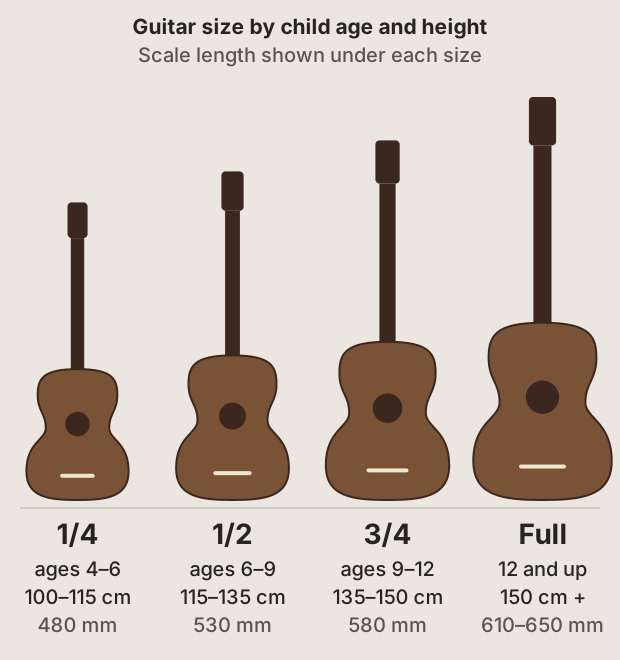
As a rough guide, children around 4–6 years old fit a 1/4 size guitar, around 6–9 a 1/2 size, around 9–12 a 3/4 size, and from about 12 or 150 cm (5 ft) tall most can play a full size. Height and arm length matter more than age, so finish with the quick fit test below.
On this page 7
Guitar size chart for kids
Size charts from different makers disagree a little, so treat this as a starting point.
| Child’s age (rough) | Child’s height | Guitar size | Typical scale length |
|---|---|---|---|
| 4–6 | about 100–115 cm (3 ft 3 in – 3 ft 9 in) | 1/4 | around 480 mm (19 in) |
| 6–9 | about 115–135 cm (3 ft 9 in – 4 ft 5 in) | 1/2 | around 530 mm (21 in) |
| 9–12 | about 135–150 cm (4 ft 5 in – 4 ft 11 in) | 3/4 | around 580 mm (23 in) |
| 12 and up | about 150 cm (5 ft) and taller | 7/8 or full | 610–650 mm (24–25.5 in) |
The fractions are names, not exact measurements. A “3/4” guitar is not three quarters of a full-size guitar in every dimension. Compare scale length (the vibrating length of the string, nut to saddle) when you shop: it is printed on most spec sheets and is the fairest way to compare sizes across brands.
The 30-second fit test
Do this in the shop, or at home before the return window closes.
- Sit the child on a chair with feet flat on the floor (use a footrest or a stack of books if the feet dangle).
- Rest the guitar on the right leg (left leg for a left-handed child) with the neck angled slightly up.
- Reach for the first fret. The fretting hand should reach the first fret with the elbow still slightly bent. If the arm is fully straight or the shoulder pulls forward, the guitar is too big.
- Check the strumming arm. The forearm should rest over the top of the body near the bridge without the shoulder lifting. If the child has to reach up and over, the body is too big.
- Try a stretch. Ask the child to place fingers on the 1st and 3rd frets of one string at once. If that stretch is impossible, go down a size.
If the guitar passes all five, it fits. If it fails one by a little, it can still work for a few months; if it fails two or more, go smaller.
Nylon or steel strings?
| Nylon (classical) | Steel-string | |
|---|---|---|
| Feel on fingertips | Soft; less sore in the first weeks | Firmer; fingertips need a few weeks to toughen |
| Neck | Wider, flatter fretboard | Narrower, easier to wrap a small hand round |
| Sound | Warm and mellow | Bright and loud |
| Typical use | Classical lessons, very young beginners | Pop, folk and rock songs, older children |
For very young children, nylon is the usual choice and many small 1/4 and 1/2 guitars come only in nylon. From about 8–9 years old, a small steel-string guitar is also a good option, especially if the child wants to play the songs they hear on the radio. Ask the teacher, if there is one: classical teachers will want nylon.
Never fit steel strings to a guitar built for nylon. The higher tension can damage it.
What to check before you buy
The size is the first decision. These make the difference between a child who keeps playing and one who stops:
- Low action. Strings that sit high are hard for small hands to press. Have the shop check it, or measure it yourself with our guide to whether a guitar needs a setup. Cheap small guitars often need this most.
- Tuners that hold pitch. A guitar that drifts out of tune sounds wrong even when the child plays it right.
- Light weight and a gig bag with a shoulder strap, so the child can carry it to lessons.
- A real guitar, not a toy. Very cheap “toy” guitars often cannot be tuned accurately. Choose a guitar made by an instrument maker.
Small steel-string guitars sold for children and travel include models such as the Taylor Baby Taylor, which Taylor describes as a three-quarter-size guitar with a narrower-than-standard 1 11/16 in neck. Compare any model you are considering on scale length and neck width.
Tune it every time
Small guitars with new strings go out of tune often, and children rarely notice. Tune before every practice with the guitar tuner: it listens through the phone microphone and shows which way to turn each peg. Standard tuning from the thickest string is E, A, D, G, B, E.
First chords that suit small hands
A few open chords let a child play along with many songs. These four use only the first three frets:
Tap a chord to hear how it should sound. E minor uses only two fingers and is the usual first chord. All four belong to the key of G major, which is why they work together so often.
When to move up a size
Repeat the fit test every six months or so. Signs it is time: the guitar looks small on the child’s lap, the strumming arm reaches well past the bridge, or the fretting elbow is folded tight when playing at the first fret. Moving up is easier than it sounds: small guitars hold some resale value, and the jump from 3/4 to full size is often made around 12, or earlier for a tall child.
FAQ
What size guitar does a 7 year old need?
Most size charts put a 7 year old on a 1/2 size guitar. A tall 7 year old may already fit a 3/4. Use the fit test, and if the child is between sizes and has a teacher, ask which the teacher prefers.
Should a child start on nylon or steel strings?
Nylon strings are softer on young fingertips and are the usual choice for small classical-style guitars. Steel strings need firmer pressure but steel-string necks are narrower. Both work; nylon hurts less in the first weeks.
Is it better to buy a bigger guitar they can grow into?
Usually not. A guitar that is too big is hard to reach around and to press, and that is a common reason children give up. A correctly sized guitar costs less, and many shops sell used small guitars, so moving up a size later is cheap.
What is a 3/4 size guitar?
A smaller guitar with a shorter scale length and a smaller body than a full-size guitar. Adults use them too, as travel guitars. Taylor, for example, describes its Baby Taylor as a three-quarter-size guitar.