Guitar Capo Guide
Updated · The Acoustic Guitarist
A capo is a clamp that presses all the strings against one fret, so every string sounds higher by one semitone for each fret the capo sits on. The chord shapes you play stay the same, but the key goes up, which lets you play in a singer's range or in a hard key using easy open chords.
On this page 7
What a capo does
A guitar capo clamps across the neck at one fret and works as a movable nut. The strings can only vibrate between the capo and the bridge, so each open string now sounds as high as that fret would normally make it. Each fret is one semitone, so a capo on fret 2 raises every string by two semitones (a whole step), and a capo on fret 5 raises them by five.
The shapes you finger do not change. An open G shape with a capo on fret 2 sounds as an A chord. The chord names you hear are different from the shapes you play, which is the whole point: you keep the easy open shapes, such as the cowboy chords, and move the key.
How to put a capo on
- Place it just behind the fret you want, on the side toward the tuners, not on top of the fret wire. Close to the fret wire gives the cleanest note and needs the least pressure.
- Keep it straight, parallel to the fret, so every string is pressed evenly.
- Clamp with just enough pressure that all six strings ring clearly. Squeezing harder than needed pulls notes sharp.
- Strum the open strings and retune with the capo on. Check every string, not only one.
Move the capo by loosening it fully, not by sliding it along the strings, which can wear the strings and the fretboard finish.
Capo chart: which chord sounds
Find the open chord shape you are playing in the first column, then read across to the capo fret. The result is the chord you hear. The table covers the five open major shapes of the CAGED set and the three common open minor shapes, Am, Em and Dm, at frets 1 to 7. Sharps and flats are the same pitch, so C# and Db are the same chord.
| Shape you play | Fret 1 | Fret 2 | Fret 3 | Fret 4 | Fret 5 | Fret 6 | Fret 7 |
|---|---|---|---|---|---|---|---|
| C | C#/Db | D | D#/Eb | E | F | F#/Gb | G |
| A | A#/Bb | B | C | C#/Db | D | D#/Eb | E |
| G | G#/Ab | A | A#/Bb | B | C | C#/Db | D |
| E | F | F#/Gb | G | G#/Ab | A | A#/Bb | B |
| D | D#/Eb | E | F | F#/Gb | G | G#/Ab | A |
| Am | A#m/Bbm | Bm | Cm | C#m/Dbm | Dm | D#m/Ebm | Em |
| Em | Fm | F#m/Gbm | Gm | G#m/Abm | Am | A#m/Bbm | Bm |
| Dm | D#m/Ebm | Em | Fm | F#m/Gbm | Gm | G#m/Abm | Am |
Every row follows the same rule: count up one semitone per fret from the chord name of the shape. Em with a capo on fret 2 sounds as F#m, and Am with a capo on fret 3 sounds as Cm.
A few shapes to start with:
How to work out the capo fret for a song
Every song you play with a capo needs two keys: the key the song is in, and the key you want to play it in.
- Find the key you hear: the key the original recording or your singer uses.
- Pick an easy key to play in, such as G, C, D, A or E, whose open chords you know.
- Count the semitones from the easy key up to the sounding key. That is the capo fret.
For example, a song in A with your shapes in G needs capo 2, because A is two semitones above G. A song in B with G shapes needs capo 4. The capo calculator does the counting and also shows the chord shapes for each capo fret. The key of G major is a common home key for capo playing, because the G, C, D and Em shapes are all open.
Playing in a singer’s range
A capo cannot lower the key. If the song is too high, play it in a lower key with different shapes, or tune down. If it is too low, move the capo one fret at a time until the top and bottom of the melody are comfortable, then write down the fret and the shapes.
Capo with open chords
Open chords ring more strings than barre shapes, and a capo keeps that open sound at higher keys. That is why many arrangements use capo plus open shapes, a trick popular with beginner songs such as those in easy Taylor Swift songs to play on guitar. It also lets you play the same song in several keys without learning new fingering. If you want to confirm a shape, the chord finder shows it.
Types of capos
Capos differ in how they clamp and in what neck they suit. This is a description of the designs, not a ranking.
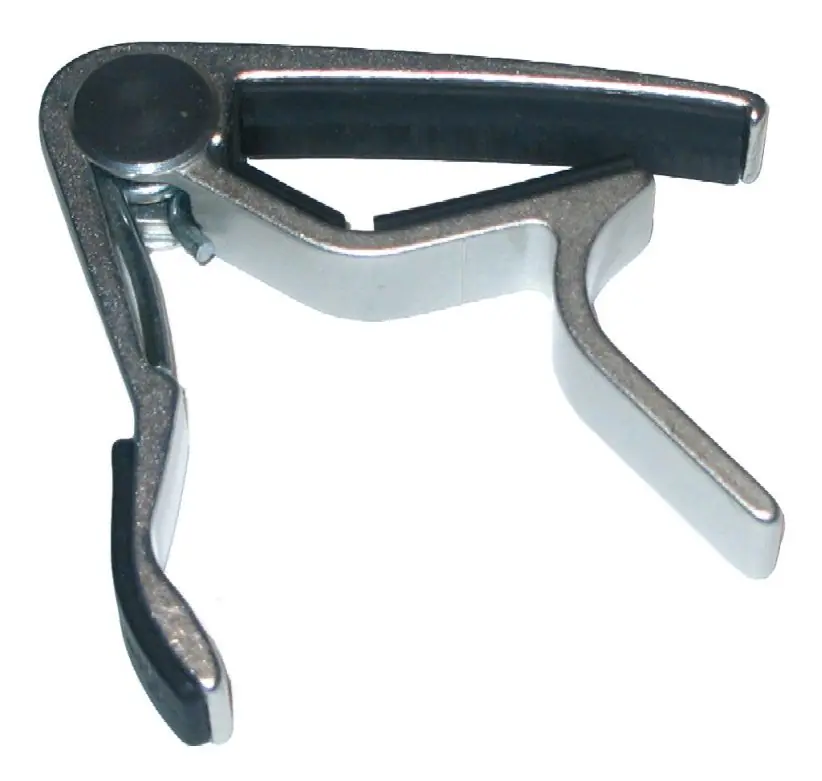
- Spring or trigger capo. A spring-loaded clamp that you squeeze to open and release to close. It can be moved quickly with one hand and is common for fast changes between songs.
- Screw or adjustable capo. A bar with a screw or knob to set the pressure. It takes longer to move, but the clamping force is adjustable.
- Lever-style capo (Shubb-style). A bar with a lever and an over-center mechanism, set with a small adjuster. Pressure is set once and then repeated each time.
- Partial capos. These cover only some of the strings, leaving others open, which produces open tunings and drone-like voicings without retuning the guitar.
- 12-string capos. Built for the wider neck and the doubled strings of a 12-string guitar.
- Curved and flat capos. Steel-string acoustic fretboards are usually slightly curved across the width, so a capo with a curved pad fits well. Classical fretboards are flatter and wider, so a flat-bar capo made for them is the usual choice.
Check the neck width and the radius that the capo is made for before buying one, since a poor fit is the main cause of problems.
Common capo problems
Strings buzz or sound muted
The capo is probably too far from the fret wire, crooked or not clamping hard enough. Move it right behind the fret and straighten it. If one string still buzzes, check that your fretting finger is not touching it.
The guitar goes out of tune after clamping
Clamping can pull strings sharp, and a capo that sits crooked pulls some strings more than others. Place it straight, clamp lightly and retune with the capo on, using the guitar tuner. If the strings only ring clean under heavy pressure, the capo may not fit the neck.
Capo vs barre chords
A barre chord uses your index finger across all the strings as a moving nut, so it does what a capo does, but with a finger that has to keep working. The difference is that a capo frees all four fingers to play the shape, so you can use open shapes in any key.
The two are not rivals. Barre chords let you change keys within a song without stopping, and a capo is simpler for playing a whole song in one key with easy shapes. Many guitarists use both: barres to move around the neck, a capo to move the key.
FAQ
Does a capo damage the guitar?
Not when it is used normally. A capo that is placed correctly and clamps no harder than needed does not harm the neck or frets. Leaving a very tight capo on for long periods can push strings sharp and put extra pull on the neck, so take it off when you finish playing.
Which fret should I put the capo on?
The one that puts the song in a key that suits your voice or the chord shapes you want to use. Count semitones from the key you play in to the key you want, and that number is the capo fret. The capo calculator does the counting for any key.
Can you use a capo on a classical guitar?
Yes. Classical guitars have a wider, flatter fingerboard, so use a capo made for it, usually a flat-bar design. A curved capo built for a steel-string neck can sit awkwardly on a classical neck.
Is using a capo cheating?
No. A capo is an standard accessory in folk, pop, country and rock. It changes the key, not the difficulty of fretting a note, and many arrangements rely on its higher open-string sound.
Do I need to retune after putting a capo on?
Often a little. Clamping can pull the strings slightly sharp. Tune with the capo already on, using a tuner such as the guitar tuner on this site.
Related
- Reading chord charts
- Capo calculatorfinds the capo fret for any key